Recoverable energy
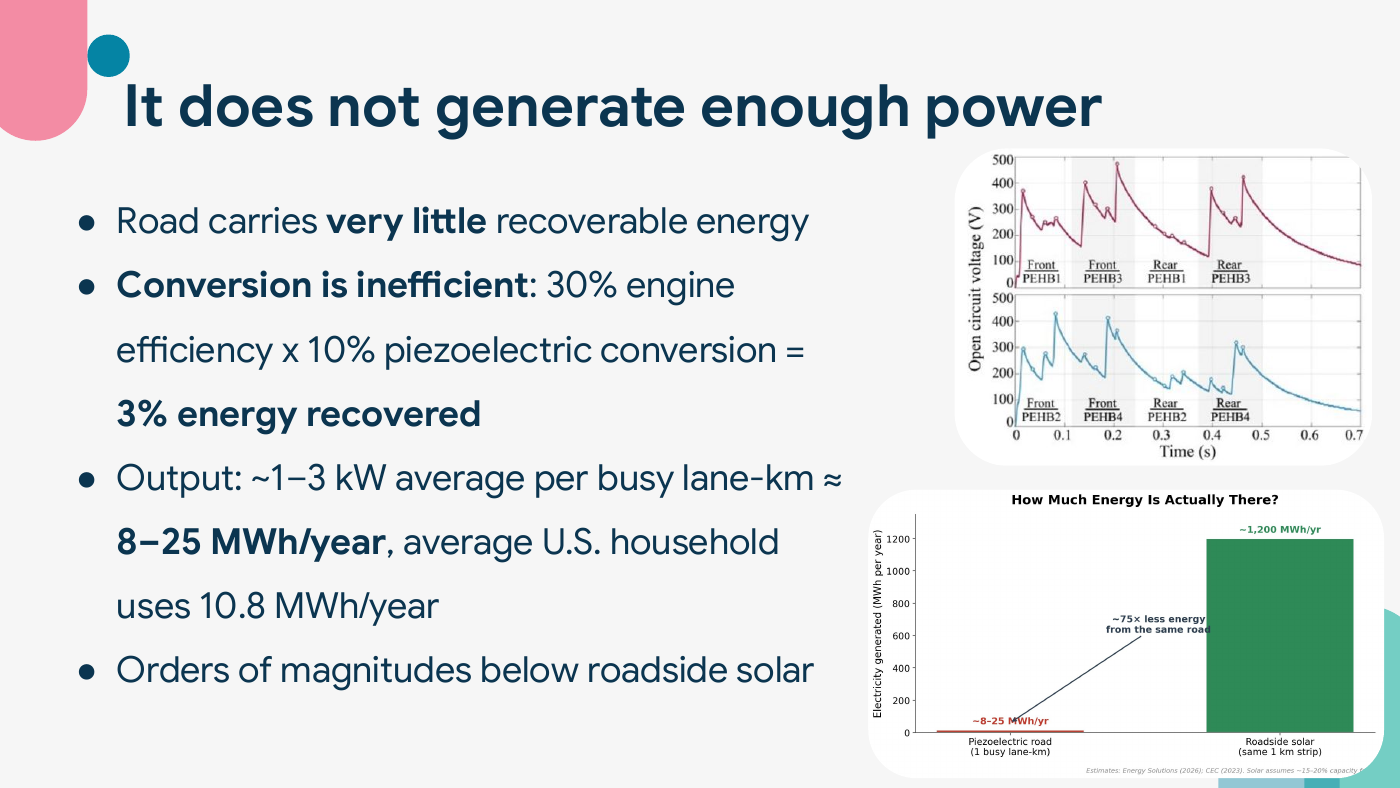
Our review found that useful output depends on more than a voltage spike. Limited road deformation and the extra energy demanded from vehicles both constrain roadway piezoelectric harvesting.
At UC Davis COSMOS, Lucas Zhou and I examined whether piezoelectric harvesters embedded in roads could be practical sources of electricity. Our meta-analysis brought together published research, comparisons of pilot projects, and our own calculations, culminating in a presentation to UC Davis faculty and a capstone poster.
Why hasn't piezoelectric road energy harvesting been widely implemented despite decades of research, and what technological and economic advances would make it viable in the future?
The evidence did not support broad deployment for grid-scale electricity.
Our review found that useful output depends on more than a voltage spike. Limited road deformation and the extra energy demanded from vehicles both constrain roadway piezoelectric harvesting.
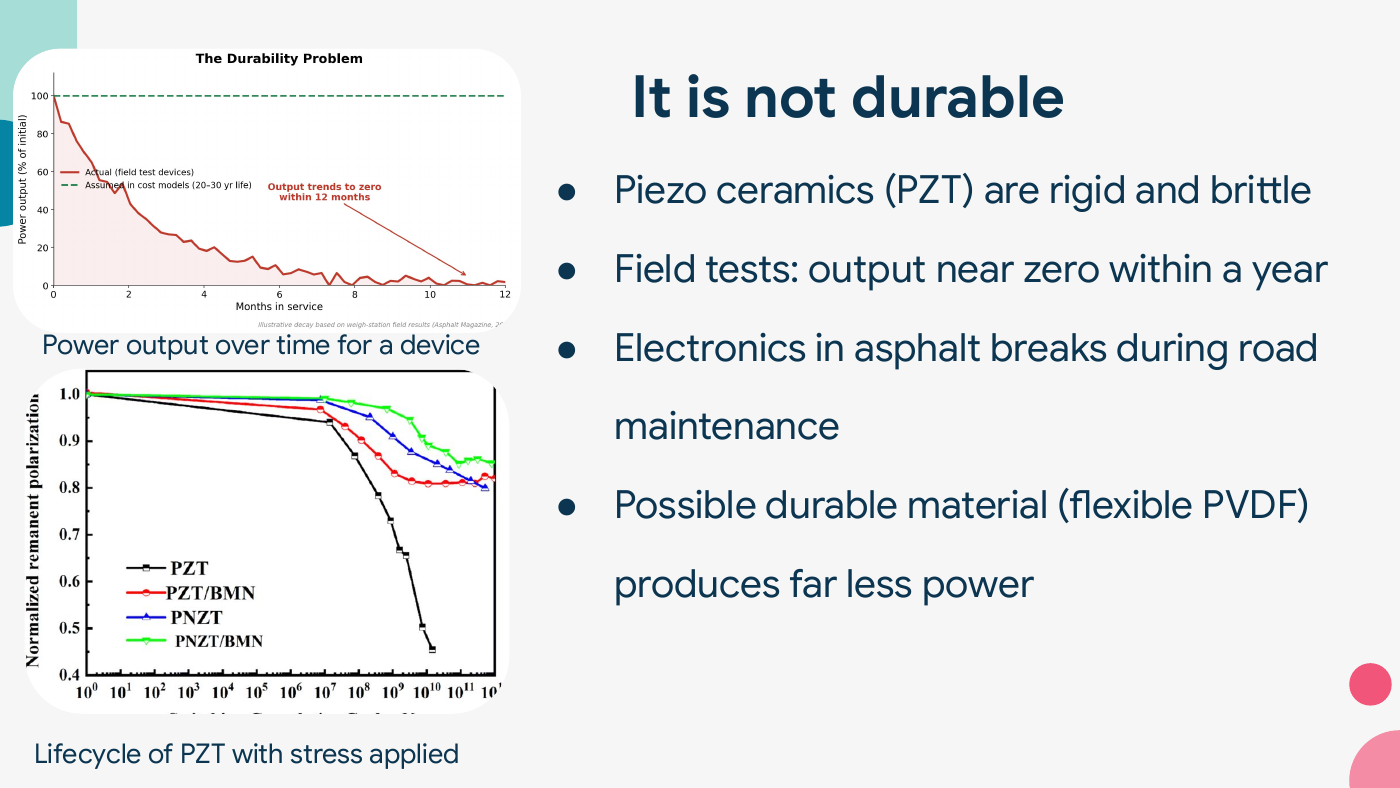
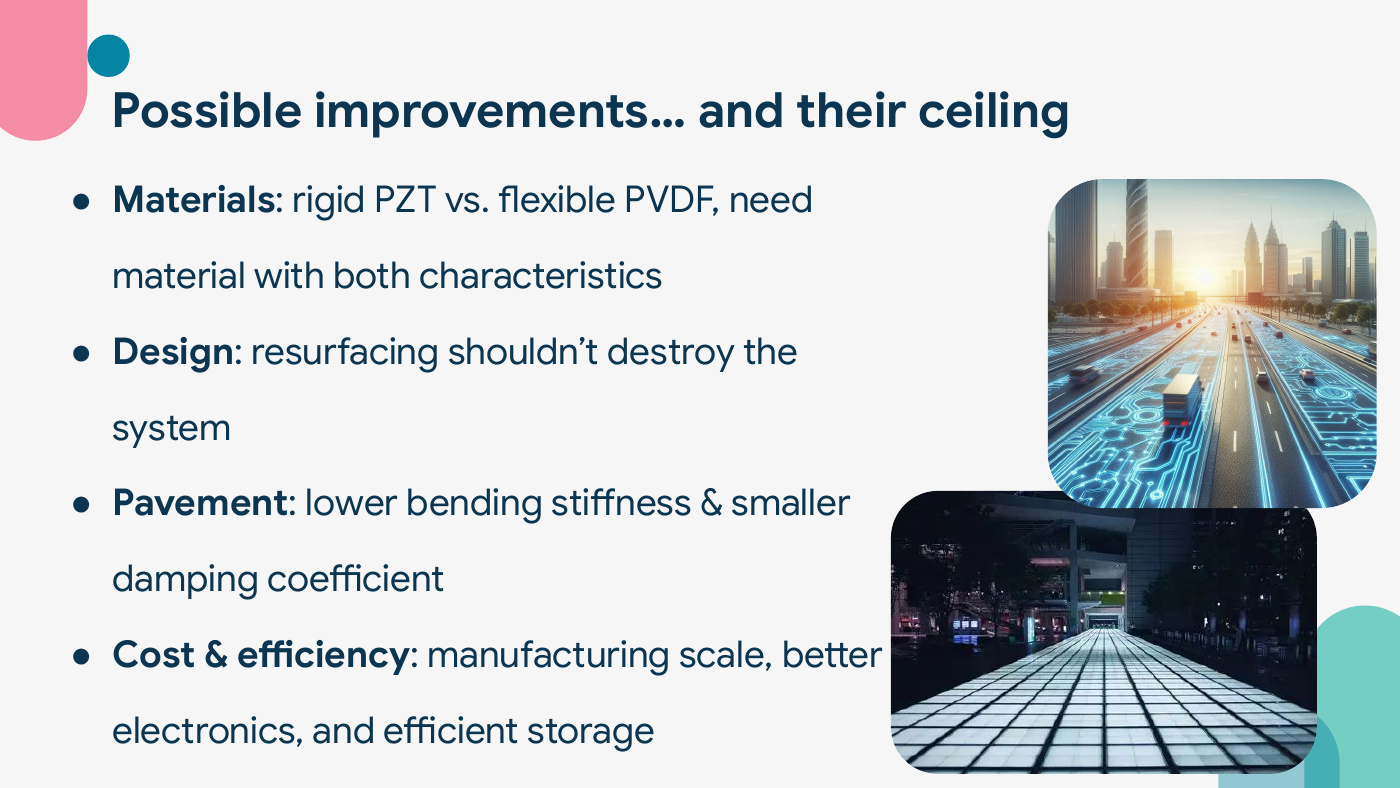
High-output ceramics are often brittle, while flexible alternatives produce far less power. Repeated traffic loads and road resurfacing make long-term reliability a central problem for sensors and other equipment embedded in the pavement.
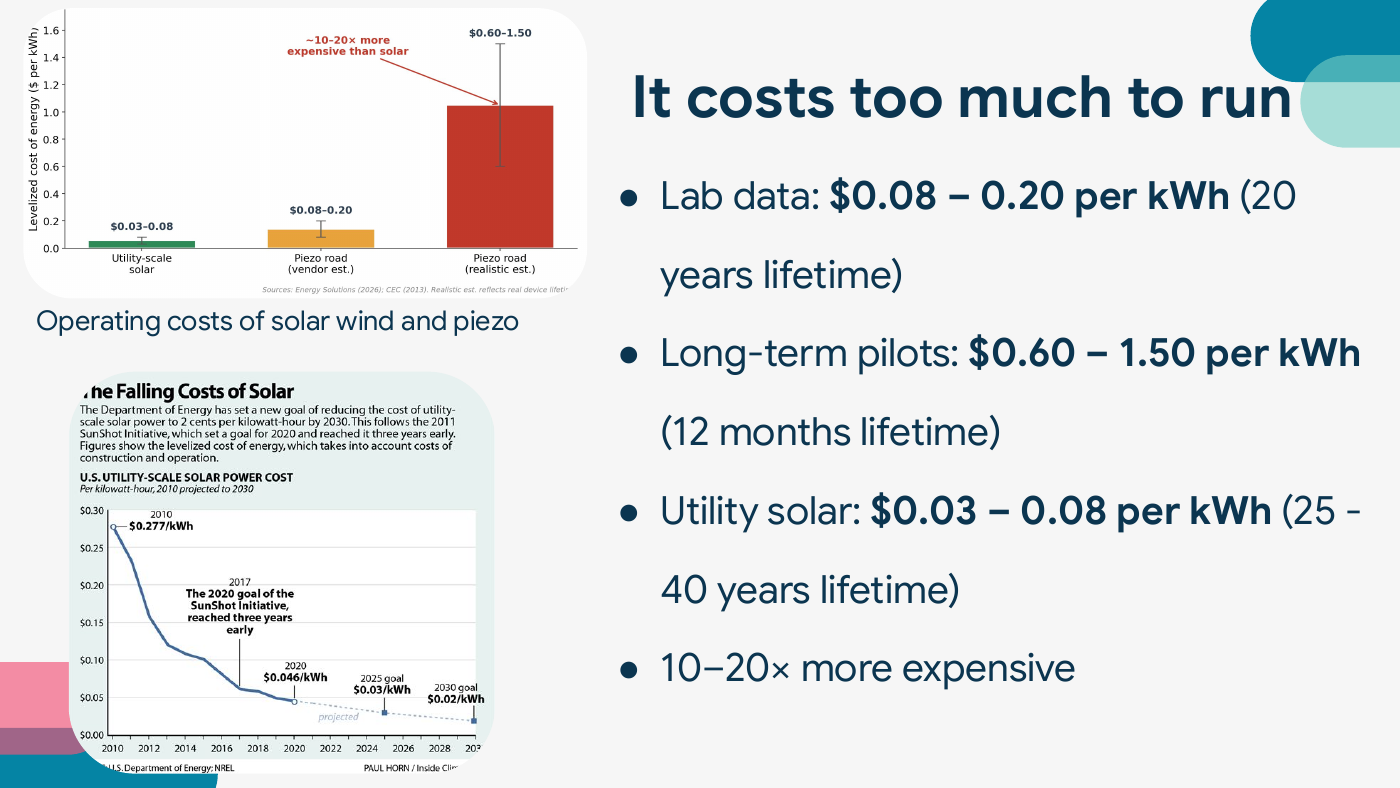
Our comparison considered device lifetime, replacement, and maintenance alongside upfront installation costs. Output estimates based on laboratory results differ substantially from the performance of pilot installations over a roadway’s service life.
Our research explored PZT-PVDF composites that combine the output of piezoelectric ceramics with the flexibility of polymers, alongside modular installations and pavement designs that could make maintenance easier. These changes could improve piezoelectric harvesting, but they would still need to be assessed against the available energy and the cost of other power sources.
The more plausible settings we considered were short segments with heavy, repeated traffic and a local use for the electricity, such as powering nearby sensors or lights.
Our seminar presentation to UC Davis faculty traced our research question through literature reviews, comparisons of pilot projects, and technical and economic trade-offs before considering more focused applications. In about 10 minutes, we explained the fundamentals of piezoelectric technology, its history and relevance, and our answer to the research question. Click the image to the left to view the full presentation.